

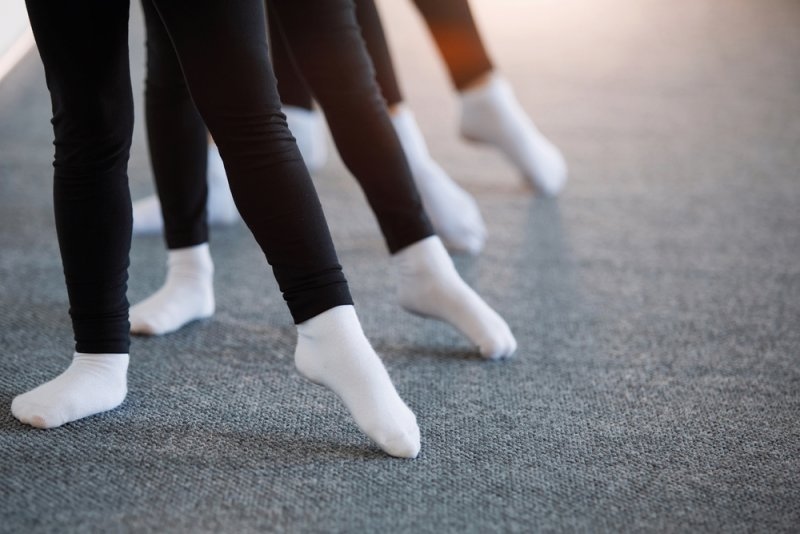
Good dance footwork is the basic skill needed for movement, change of direction, weight shift, and connections between movements. Good footwork will help dancers move better and in time with music. This skill does not depend only on how fast dancers move their feet. It depends on other factors too.
Accuracy comes before speed. If the pattern is not consistent when done slowly, doing it fast will definitely make you repeat the same errors.
To start with, try to determine the weight shift in all the steps. It is important to know which foot carries your weight before shifting to the other one. Start practicing the steps slowly until everything becomes consistent.
A metronome or some form of music can help you learn timing. When you get the steps to be easy for you, start increasing the tempo little by little but still making sure the placements are the same. Video recording during your practice sessions can help you identify rushed steps or unnecessary jumps.
Practicing is effective because it is specific rather than just lengthy. Learn a short combination step-by-step:
The practice of shorter duration is more effective than the one that takes place when you are tired. If the technique breaks down, slow down.
Also check: Importance of Dance in Health, Culture, and Growth
Apply the following footwork drills to make training effective:
There are different approaches for different styles; however, there are some footwork techniques that can be applied in any genre of dancing.
The shift of weight is essential. Prior to shifting any part of the body or foot, determine what will be the direction of the shifting of the body weight.
A turn requires preparation. The supporting leg should be fixed, abdominal muscles engaged, and spotting may be used when necessary. It is better to prepare than to try to rotate faster.
The following practice methods will be useful for developing footwork skills in different types of dances.
Stand in a relaxed position and shift your weight from one side to the other, tapping your foot that is not bearing the weight. Make sure that you have a soft bend in the supporting knee and try to increase the tempo without swinging your body too much.
Balance on one leg for a period of time before switching legs. Increase difficulty by incorporating a slight tap of the leg. Balancing is important to dancing as dancers often balance on one leg with the other moving.
It becomes effective to practice footwork exercises if you identify one particular weakness. If a dancer wants to improve speed, he/she may repeat the same three or four steps, while for the one experiencing problems in transitions, it is advisable to constantly link two hard steps.
One can use a metronome or even a music beat, but do not forget that everything should be of good quality. In case the dance step is quite complicated, split it into two or four counts and only then link.
Increase speed slowly. Begin at a speed that will allow you to perform all the steps clearly before increasing the speed. Don't make your movements overly big. Small steps may often be more effective when done quickly. The body should remain relaxed, with the shoulders not lifted at increased speeds.
Must Read: Stretching for Dancers: Build Flexibility and Prevent Injury
Good footwork involves linking up the steps to the music, understanding the accents, breaks, and rhythm changes.
Count out loud the combination before doing it to the music. Clapping or tapping the rhythm is another approach that will help you separate musicality from the actual performance of the combination.
A practice period that lasts for about 20-30 minutes might consist of lower body warm-ups, balance exercises, one particular drill, traveling combinations, and running through them to the music.
It is possible to make the same mistake that many people make, which is trying to be fast even before knowing the sequence. Another thing that can slow down the weight transfers is locking the knees.
Another bad habit can be to work out just the stronger leg. It will be helpful to practice movements in different directions.
Effective dance footwork is ensured by the accurate execution of the technique and repetitive training. Begin gradually and learn the weight shifts until they become consistent. In addition, do not use only choreography; also include exercises such as balance, directional change, and rhythm practice.
Speed and coordination can be improved by doing slow footwork exercises and then gradually speeding them up. It is advisable to practice exercises which involve quick movements, shifting the weight, changing directions, and rhythm patterns. Timing and coordination can also be practiced by counting while dancing, by practicing both sides of the body, and through the use of a metronome.
It is advisable to learn complicated footwork by dividing it into parts rather than doing the whole exercise at once. One should start by learning the rhythm, do the steps slowly, and learn the weight shift.
Try to practice your footwork several times a week, instead of using longer sessions sporadically. Just ten to twenty minutes of concentrated practice can help if you are concentrating on each specific aspect of the skill, such as timing, balance, speed, or weight transfers. Take time to recover if your feet and calves hurt.
At higher tempos, footwork usually becomes messy since the body lacks the control at those speeds. Reduce the tempo and work on precise foot placement, full weight transfers, and transitions. Increase the tempo gradually. If the technique collapses, go back to the earlier tempo and proceed from there.
There are benefits in both types of practice. Without music, you can concentrate on foot placement and weight transfers, and with music, on timing and musicality. Start with slow counts or a metronome and then proceed to music.
This content was created by AI